
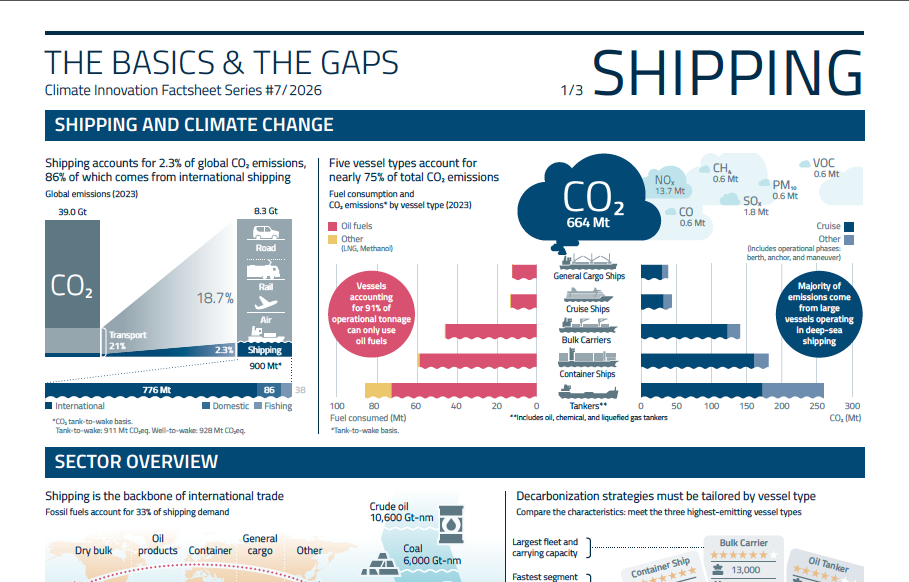

Shipping carries over 80% of global trade by volume and accounts for 2.3% of global CO₂ emissions, yet vessels representing 91% of the operational tonnage can currently use only oil fuels. Our new factsheet sets out the key facts and figures on decarbonizing shipping, and the gaps that remain.
Some of our key takeaways are:
- There is no silver bullet. The right solution depends on vessel type, trade pattern, and energy requirements.
- Five vessel types (general cargo ships, cruise ships, bulk carriers, container ships, and tankers) account for nearly 75% of shipping’s global CO₂ emissions. This makes them the starting point for action.
- Conventional marine fuels are hard to replace. Oil fuels still offer superior energy density and cost, while every alternative faces trade-offs in cost, technology readiness, environmental performance, and safety.
- Infrastructure is a key bottleneck. Decarbonizing the maritime industry requires around 280 Mtoe of low-carbon fuels, while the industry consumes 1 Mtoe per year today. Operators, fuel producers, and ports are each waiting for the others to move first.
- Technologies to cut emissions exist today. Wind-assisted propulsion can deliver fuel savings of up to 30% per nautical mile. Efficiency measures can reduce energy use on every vessel type.
- Policy can break the standoff through long-term regulatory certainty, offtake agreements, low-carbon bunkering and shore power infrastructure, and adoption of the International Maritime Organization (IMO) Net-Zero Framework.