Building Europe’s Future: More Ambition and Ingenuity, Less Material and Lower Emissions / Dr. Michiel Scheffer and Dr. Peter Schniering
In Europe’s established industrial heartlands and metropolitan start-up labs, the continent’s next industrial chapter is already being written. This is not a story of sweeping away the old to make room for the new. It is about combining Europe’s industrial capabilities with scientific excellence and entrepreneurial ingenuity. The result is an opportunity to make climate action a driver of investment, productivity, and growth.
Nowhere is this opportunity more tangible than in construction. Deeply rooted in Europe’s industrial heritage, the sector relies heavily on cement and steel, whose production accounts for a disproportionate share of global emissions. It is also on the cusp of transformation, as advances in materials, computational design and manufacturing open entirely new possibilities for how we build.
This was the idea at the heart of the collaboration between Future Cleantech Architects (FCA) and the European Innovation Council (EIC) at the Future Cleantech Festival 2026. Across several festival formats, we explored how breakthrough innovation can fundamentally change the way tomorrow’s buildings are designed, constructed, and used.
The most visible expression of this partnership was a major joint demonstrator: the Universal Timber Slab, developed at the University of Stuttgart with EIC support. Its full-scale, eight-by-five-meter structure shows how computational design, structural engineering, and robotic fabrication can work together as an integrated process. By aligning timber elements with the actual flow of forces, the system enables large spans and flexible floor plans while reducing reliance on carbon-intensive materials.
During the festival, the demonstrator became the setting for the technology’s first full-scale load test—a tangible moment when advanced research met real-world performance.
The collaboration extended from demonstration to dialogue. In a dedicated Solutions Hub, the pioneers behind the Universal Timber Slab were joined by the start-ups ArchiBioFoam and AM2PM to present disruptive approaches to construction. Their solutions spanned digital fabrication, new materials and design for longevity. Together, they demonstrated how durability, resource efficiency and aesthetics can reinforce one another.
But transforming construction is a systems challenge. It requires architects, engineers, policymakers, investors and innovators to rethink the entire value chain.
A central theme connects these solutions: structural efficiency. Climate action in construction cannot focus solely on making each tonne of material cleaner. It must also ask how much material a structure genuinely needs to fulfil its purpose. Designing closer to that structural minimum can reduce demand at source, lower embodied emissions, ease cost pressures and make low-carbon materials more competitive. Because this demand-side approach can be applied wherever buildings and infrastructure are created, European innovation has the potential to deliver emissions reductions far beyond Europe.
That is the broader promise captured in this collaboration and it extends well beyond construction. Europe does not have to choose between its established industrial strength and its emerging innovation ecosystem. By bringing them together, it can compete on new terms, creating solutions that are resource-smart, globally relevant and economically compelling.
To those who doubt Europe’s ability to compete, the answer is already taking shape: when industrial strength and breakthrough innovation work together, Europe can decarbonize, prosper and lead.
Made in Europe. Built for the future.
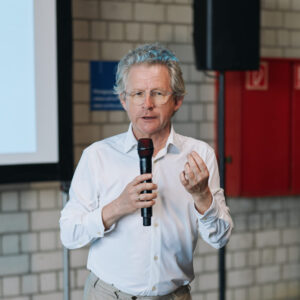
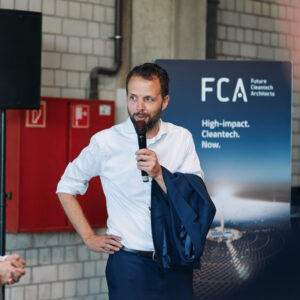
Dr. Michiel Scheffer is the President of the Board of the European Innovation Council.
Dr. Peter Schniering is the founder and CEO of Future Cleantech Architects.