
Blogpost by Dr. Marlène Siméon (marlene.simeon@fcarchitects.org), Director of Policy, and Tal Harris, Head of Communications
The European Commission’s Electrification Action Plan marks a meaningful shift in European industrial and energy policy. Electrifying the economy is not only a climate objective, but the foundation of a competitive, energy secure, and resilient Europe.
The Plan – closely aligned with many recommendations we have made in recent years – is ambitious in scope, touching grid flexibility, industrial heat, thermal energy storage, and clean firm power.
The challenge now is implementation. While the Action Plan’s narrative is compelling, rapid deployment hinges on many of the financial and regulatory mechanisms to be developed.
Three Important Advances
1. Flexible Grids
The Plan rightly places grid flexibility front and center.
The Commission recognizes that flexibility reduces overall system costs, while making electrification more affordable for businesses and consumers. This reflects an important shift in thinking: building more grid infrastructure alone will not be enough. Europe also needs to make better use of the existing electricity system.
Here are some welcome measures concerning the grid:
- A 200 GW storage target by 2030.
- Explicit recognition of the need for long-duration energy storage.
- Thermal energy storage is identified as an industrial flexibility solution.
- A KPI bringing the electricity to gas price ratio down to 2 for industry.
- A network charges reform to reward flexible electricity consumption.
- New work to assess flexibility potential across European industries.
Together, these measures – aligned with what FCA has consistently argued – point toward a system that is cleaner, more affordable, and better able to absorb growing volumes of renewable electricity.
2. Electrifying Industrial Heat
The Plan also recognizes that commercially available technologies can already electrify a significant share of Europe’s industrial heat demand.
Electric boilers, industrial heat pumps, and electric arc furnaces are no longer emerging technologies. They are proven industrial solutions that can reduce emissions, advance Europe’s industrial competitiveness, and reduce dependence on imported fossil fuels.
High temperature heat makes up about half of heavy industry’s emissions, making continued innovation essential. That is why the Plan’s commitment to a second Innovation Fund auction focused on industrial heat electrification is particularly encouraging.
The economics of electrification will determine how fast this can scale. The KPI to bring national electricity-to-gas price ratios down to a maximum of 2 for industry by 2030, recognizes that relative energy prices are the key variable in investment decisions.
FCA’s dairy sector case study, referenced by the Commission, demonstrated that for example high-temperature heat pumps can break even with gas systems over a 10-year period once the electricity-to-gas price ratio reaches around 2. This is evidence that this cleantech solution is investment-ready under the right energy price conditions, reinforcing the importance of creating a favorable investment environment for industrial electrification.
Our techno-economic analysis of a representative German dairy facility compared electric boilers, high-temperature heat pumps and thermal energy storage across a range of electricity and gas prices. The analysis shows that investment decisions are primarily driven by the electricity-to-gas price ratio. While electric boilers offer lower upfront costs, heat pumps deliver substantially lower lifetime costs. Adding thermal energy storage, typically representing less than 20% of total system CAPEX, reduced electricity costs by around €10/MWh through twice-daily load shifting, demonstrating that flexibility can be delivered at relatively low cost.
3. Electrification in Aviation and Shipping
Another notable shift is the recognition of electrification’s role beyond road transport.
The Commission acknowledges opportunities for electric propulsion in short-haul aviation and maritime transport. These two sectors alone are responsible for much of Europe’s emissions and dependency on imported fossil fuels. It broadens the range of pathways available to sectors traditionally viewed as difficult to electrify, bringing us closer to a future of industrial and energy autonomy.
Three Areas where the Plan Is Short on Details
1. Electrification-First
This approach is aligned with Europe’s Energy Efficiency First and FCA’s own analysis Wherever direct electrification is technically feasible, it should remain Europe’s first default choice. Direct electrification delivers greater energy efficiency, reduces system costs, and limits dependence on scarce clean fuels for sectors that will need them. It is unfortunate that the Plan does not enshrine this as an explicit principle guiding funding and regulatory decisions, leaving it as an implicit priority.
The Plan does recognize complementary roles for hydrogen and other low-carbon technologies for industrial activities that cannot currently be electrified. In our Hydrogen Guardrails report, we explain why clean hydrogen should only be deployed where it is an indispensable industrial feedstock or where there are no other cost-effective or energy efficient decarbonization options.
2. Innovative Future Renewable Energy Technologies
The Plan rightly focuses on deploying today’s commercially mature technologies, but Europe’s long-term competitiveness and decarbonization will also depend on accelerating the next generation of renewable technologies.
With the Renewable Energy Directive (RED-III), the EU already recognized the importance to invest in more innovative renewable technologies. This is key to remove barriers and mainstream technologies with significant long-term potential like airborne wind, concentrated solar power or wave energy – to name just a few of a broad portfolio of technologies that remain underdeveloped.
Nevertheless, our analysis earlier this year finds many countries are still lagging on implementation. And, unfortunately, the Electrification Action Plan gives this next-generation pipeline only little attention where future technology deployment is discussed.
Europe will require a broader portfolio of dispatchable renewable electricity technologies alongside today’s commercially mature technologies. That means stronger support mechanisms, clearer investment signals, and a long-term framework extending beyond 2030.
3. The Missing Role for Next-Generation Geothermal
Enhanced geothermal systems could unlock a technical potential of nearly 40 TW in Europe. This is ≈35 times the EU’s entire installed electricity-generation capacity today. It has the potential to provide abundant clean firm power across Europe, generating reliable electricity regardless of weather conditions. As Europe’s electricity demand grows through electrification, this type of dispatchable generation will become increasingly valuable.
However, it stops short of explaining how the proposal will build on Accelerate EU or how much next-generation geothermal could contribute to Europe’s future electricity mix. AccelerateEU begins filling this gap through proposals around derisking mechanisms and a geological EU database.
FCA and its partners are encouraging policymakers to consider the great potential of this geothermal energy, requiring drilling beyond 5km kilometers, with massive clean firm power benefits that a highly electrified economy will need.
From vision to delivery
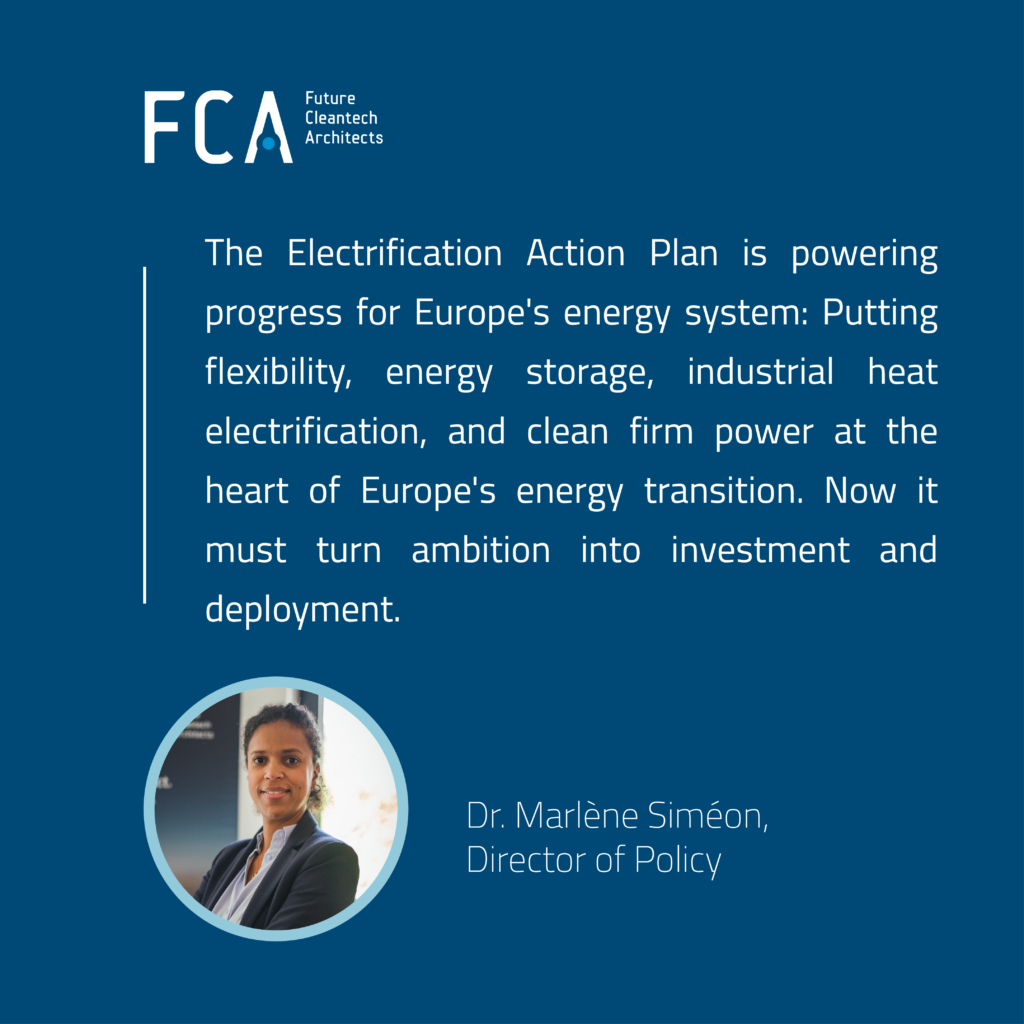
The Electrification Action Plan is powering progress for European energy policy.
It recognizes that competitiveness, industrial policy and energy security increasingly depend on abundant clean electricity.
It tells the right story. The KPIs, the storage targets, the 100 billion € industrial decarbonization bank make that clear.
Clear financing mechanisms, stronger investment frameworks, stable regulatory signals, and continued support for innovative cleantech will determine whether Europe’s electrification ambitions actually shift its industrial trajectory. It will also have to quickly solve how AccelerateEU’s geothermal short-term measures and the new Plan feed into a dedicated Geothermal Action Plan, and whether “electrification-first” becomes a binding principle rather than an assumption.