Policy Brief on Powering and Heating Europe: The Case for Next-Generation Geothermal
Policy Brief on Powering and Heating Europe: The Case for Next-Generation Geothermal
There is abundant geothermal potential to power and heat Europe. Our new Policy Brief on Powering and Heating Europe: The Case for Next-Generation Geothermal delves into policy pathways to finance and deploy this resource.
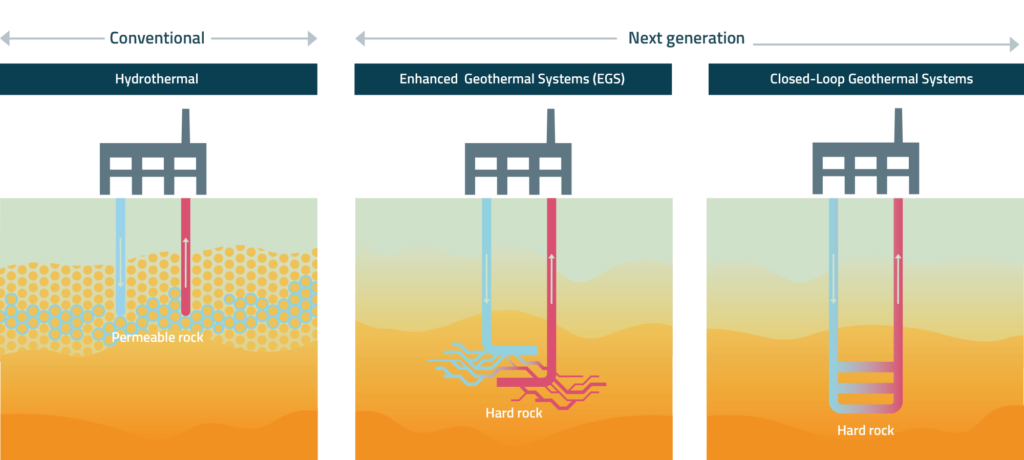
Conventionally, geothermal energy needed three things in the same place: heat, underground water, and permeable rock. Few places in Europe have all three. But next-generation technologies, such as enhanced geothermal systems (EGS) and closed-loop systems, engineer around these limits. This opens up geothermal across far more of Europe.
Executive Summary
Geothermal energy is entering a new era. For more than a century, conventional geothermal has been limited to the relatively rare regions where heat, underground water, and permeable rock naturally occur together. As a result, outside of those locations, it contributes virtually nothing to the world’s energy supply. Next-generation technologies, notably Enhanced Geothermal Systems (EGS), closed-loop geothermal and, further ahead, superhot-rock resources which would increase the economic and geological potential, are beginning to relax these geological constraints thanks to improved engineering techniques, thus expanding the potential resource. Geothermal can deliver much-needed round-the-clock clean energy in multiple ways, whether as a source of heat or power, cooling and seasonal storage, enhancing Europe’s energy security and supporting the decarbonization of its economy. These approaches are at different stages of maturity, and their commercial prospects vary. Together, they offer a potential source of domestic heat and, where temperatures and project economics allow, clean firm electricity.
The scale of the opportunity is significant, with some estimates that Europe has up to 40 TW of technical potential for EGS power generation within 8 km of depth; this is equivalent to around 35 times Europe’s current total installed electricity capacity. The central question for Europe is therefore not whether the geothermal resource exists. It is whether the technologies, supply chains, business models, and financial instruments needed to access it can be developed at a competitive cost. The policy objective should therefore be to use public intervention to move geothermal projects from geological potential to commercial certainty, identifying projects with credible economics, reducing the cost and risk of accessing the subsurface, and generating enough deployment and operational evidence to determine where next-generation geothermal can compete.
Policy Recommendations:
The EU’s energy framework increasingly recognizes the need for flexibility, yet system planning insufficiently factors clean firm power in the mix, i.e. clean generation capable of providing reliable and predictable generation with high capacity factors, complementing variable renewables when these are unavailable for extended periods. Geothermal competes poorly if it is assessed only through the lens of current LCOE versus more mature wind and solar. Its value proposition is different: predictable generation, high utilization, direct heat provision, and combined heat and power. The EU and member states should:
- Recognize clean firm power technologies, including next-generation geothermal, in the post-2030 energy framework (REDIV).
- Extend the REDIII innovative renewable technologies target into the post-2030 framework with clear implementation measures and reporting on actual deployment.
- Allow eligible geothermal projects to participate in capacity mechanisms where they can demonstrate that they provide the relevant service and integrate next-generation geothermal explicitly into member states’ long term capacity planning and national energy and climate plans (NECPs).
- Assess technologies and geothermal projects according to their actual contribution to reliability, emission reduction, and system value.
District heating and low-temperature industrial heat offer the nearestterm, strongest business case for geothermal in Europe, given the large addressable market (700 TWh/year of industrial heat demand below 200°C) and the lower upfront cost compared to hotter, deeper power generation wells. These projects can provide an earlier commercial opportunity than deep electricity projects and help develop critical capabilities for the overall sector, from drilling and subsurface characterization to project development and financing. Our recent report with Project InnerSpace preliminarily scores and maps out the potential for identifying industrial clusters that can be running their heat on geothermal resources by analyzing factors such as subsurface conditions, aquifer stress, seismicity, and heating demand. Medium-temperature industrial heat above 200°C12 represents the next tier of opportunity as drilling reaches greater depths.
The EU and member states should:
- Develop standardized heat purchase agreements (HPA) for municipalities and industrial consumers and encourage business models such as heat-as-a-service (HaaS), in which a geothermal developer finances, owns and operates the geothermal system while the customer pays a fixed price per unit of delivered heat with zero CAPEX burden. This can help overcome the upfront CAPEX barrier faced by industrial consumers and it allocates project risk to the most appropriate stakeholders.
- In addition to the output-based auctions for renewable heat, of 2025 and 2026 which should advertise geothermal eligibility more vocally to attract more proposals, create specific grant calls for next-generation geothermal under the Innovation Fund as it is difficult to compete only on the basis of €/CO₂ cost of abatement with heat pumps and e-boilers.
- Target industrial heat clusters and suitable industrial sites to aggregate and concentrate demand in order to share and reduce project development costs.
The largest risks in next-generation geothermal are concentrated at the beginning of the project, before the project generates revenue: Developers have to spend substantial amounts of capital exploring and drilling before knowing definitively whether the resource will perform as expected. Public intervention should therefore focus on early-stage risk. The EU and member states should:
- Rapidly establish a centralized, open-access European geothermal subsurface database as was announced in the AccelerateEU Communication, with high-quality public data characterizing geothermal resources across Europe (e.g. geological maps of temperature, depth, seismicity, and other subsurface characteristics). This should build on existing EU geological data initiatives and ensure data collected with public support becomes publicly available after appropriate confidentiality periods.
- Establish or expand exploration insurance and guarantee schemes covering a proportion of the risk of unsuccessful or underperforming first wells, drawing on national experience including Germany recently.
- Encourage national promotional banks and the European Investment Bank (EIB) to provide risk-sharing instruments for early exploration and even provide partial coverage against unsuccessful or underperforming exploration wells. Geothermal is a CAPEX-heavy technology, so the cost of financing has a major impact on the LCOE. An EU facility to national, regional, or local banks should target the gap before the resource performance is proven.
Early projects need a credible route to revenue as well as lower exploration risk. Long-term contracts and appropriate market arrangements can help. Policy should also ensure that, when appropriate, markets can remunerate the services geothermal provides. Potential early offtakers include industrial consumers, utilities, data centers and large corporate customers willing to pay for reliable clean energy, whether electricity or heat. The EU and member states should:
- Facilitate long-term power purchase agreements (PPAs) for geothermal power and heat plants, at least on non-flexible parts, and encourage business models like heat-as-a-service, decoupling infrastructure ownership and financing from energy use by customers under long-term contracts to address upfront investment barriers.
- Aggregate projects into portfolios to attract financing, by diversifying risks that are spread across various projects (some geothermal wells will perform better than expected, some worse, and some exploration wells may be unsuccessful).
- Take advantage of co-benefits: Geothermal can deliver heat as well as power, storage, and cooling for homes and industry. It also has the potential to co-extract valuable resources like lithium from geothermal brines.
The scale-up of geothermal ultimately depends on bringing down drilling costs and building the industrial capabilities to deploy wells at scale. Europe has a strong industrial base, but the current drilling ecosystem is too small to generate the learning rates required for rapid cost reduction. Policy should therefore support both technology innovation and deployment at scale. The EU and member states should:
- Invest in research and development (R&D) into faster and deeper drilling technologies, which can have a powerful effect on project cost, and create regulatory sandboxes where appropriate for testing those novel geothermal technologies. This is also where Europe’s industrial policy can become strategic.
- Use European innovation programs to support technologies moving from demonstration towards commercial deployment, and include innovators in the Geothermal Stakeholder Partnership announced in the Electrification Action Plan.
- Make permitting more predictable and standardized, reducing fragmentation both within member states (one-stop-shop) and across member states. Identify acceleration areas for next-generation geothermal where prior data and environmental assessments help to get faster decisions.
- Set proportionate risk-based rules for geothermal stimulation and induced seismicity. Require baseline studies, clear monitoring, public communication, mitigation plans and seismicity protocols for EGS projects involving hydraulic stimulation, based on the actual risk profile of geothermal projects. Clear risk-mitigation protocols for induced seismicity, particularly in jurisdictions with prior sensitivities, can ensure public acceptance and foster community engagement.
- Incentivize workforce and technology conversion from the oil and gas industry, given that a majority of geothermal technology investment overlaps with existing oil and gas drilling, evaluation, and surface expertise, and that Europe’s oil and gas services sector still has a strong manufacturing base, workflows, capital and trained labor. Several of the world’s largest oil & gas companies are European. This will help repurpose relevant industrial capabilities towards a growing cleantech market.
Geothermal is a technology with global potential. Not only does this increase the spillover impact for emissions reductions, it also represents an economic opportunity. The EU should strengthen its cooperation with countries at the forefront of next-generation geothermal. This would help scale up and accelerate learning on all key components of the sector, including drilling, subsurface characterization and reservoir engineering, as well as surface plant equipment. Geothermal is particularly well suited to international cooperation, as much of the learning is transferable across geologies. The EU and member states should:
- Use EU international energy dialogues and partnerships, and Global Gateway as announced in AccelerateEU, to establish a dedicated geothermal cooperation track with leading and partner countries such as the United States, Japan, Iceland, Türkiye, and Kenya.
- Support joint R&D and demonstration projects, technical expertise exchanges, drilling know-how, risk mitigation protocols, and facilitate partnerships around first-of-a-kind projects and deployment.
- Help European start-ups access demonstration opportunities and different geologies outside Europe, allowing them to test technologies, build operational experience, and accelerate learning. At the same time, the EU should encourage foreign companies developing next-generational geothermal technologies to demonstrate and build plants in Europe, in partnership with European companies and research organizations. This can accelerate technology transfer and foster European know-how, industrial capacity, and supply chains, in line with the objectives of the Industrial Accelerator Act.