
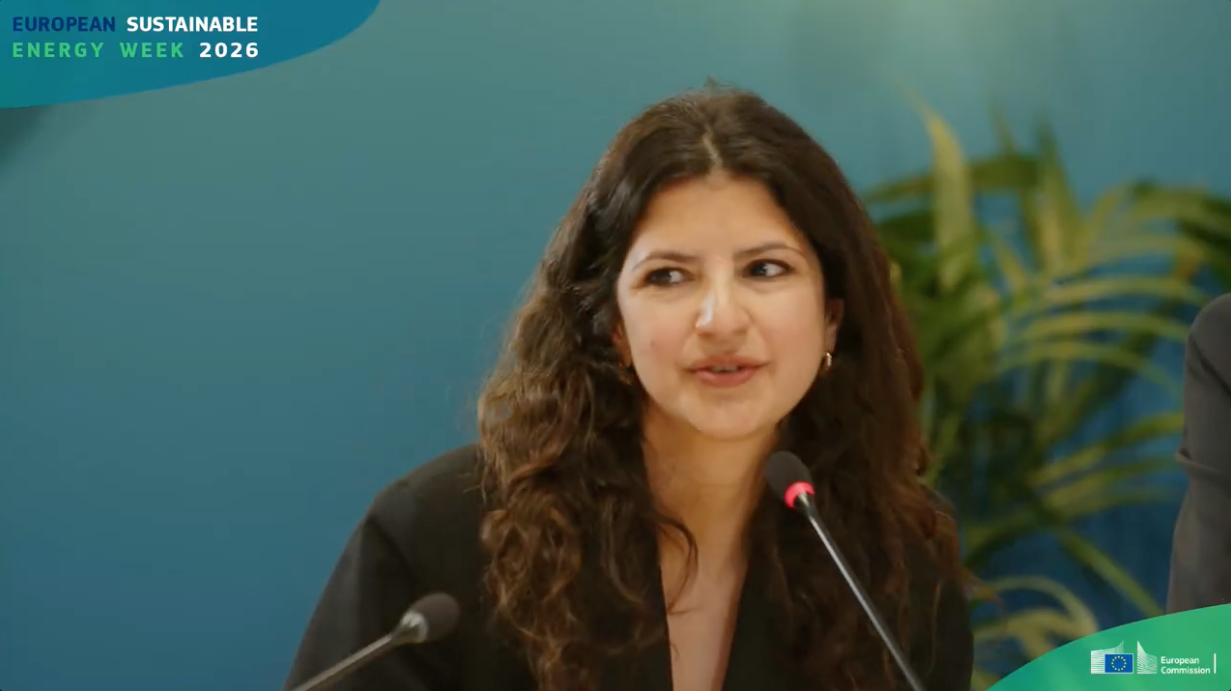

“Hydrogen is central to key industries, but today it mostly depends on fossil fuels. As Europe scales clean hydrogen, it must use this scarce resource wisely and stay open to innovation, including direct electrification” – Magnolia Tovar.
We were grateful to join European Sustainable Energy Week 2026 in Brussels for the session “Shaping Europe’s hydrogen future: key priorities for a new EU strategy,” moderated by Kitti Nyitrai, Head of Unit at the European Commission’s Directorate-General for Energy.
The event brought together voices from across the hydrogen value chain to help inform the upcoming revision of the EU Hydrogen Strategy.
Our Director of Technologies & Impact, Magnolia Tovar, made two key points:
A Pro-Innovation Strategy:
Hydrogen deployment should support decarbonization, but leave room for nascent technologies to emerge. In sectors such as steel and fertilizer production, direct electrification and other clean solutions may play a growing role as they mature. The EU should remain open to that progress.
A Sectoral Approach With Guardrails for Public Funding:
The revised hydrogen strategy should start by assessing the sectors Europe is trying to decarbonize and adopt a sectoral approach, with guardrails to ensure that hydrogen is deployed in the most cost-effective and energy-efficient way for decarbonization.
Our contribution builds on some of FCA’s most impactful work in 2025, when we supported EU legislators with evidence during the adoption of the Delegated Act, providing much-needed regulatory clarity on the definition and accounting of low-carbon hydrogen.
We are committed to supporting the decarbonization of hard-to-abate sectors through a sectoral approach, one that treats hydrogen as an enabler where it is needed, while leaving room for innovation and complementary technologies, such as direct electrification.